
Discover Worms, Germany – Highlights & Local Tips
When you arrive in Worms, you quickly notice:
Worms doesn’t merely tell history – it lives it. The city sits along a flood-protected stretch of the Rhine, between the mouths of the Eisbach and the Pfrimm, in a landscape that drew people here very early on. Archaeological findings for the area of today’s city point to an exceptionally long continuity of settlement – a fitting reminder that Worms was less “founded” than it was shaped and expanded over millennia. Its oldest recorded name, Borbetomagus, is of Celtic origin; in the Augustan era, Worms and its surroundings belonged to the Roman sphere of power. Later, the town appears with an official Roman designation, and in late antiquity Worms becomes a borderland again – complete with fortifications as a response to uncertain times.
In the city’s story there are turning points that read like hinges: early Christianity, the formation of a bishopric, its role as a royal palace site in the Carolingian period – and then the High Middle Ages, when Worms rises to become a centre of political and ecclesiastical power. The Salian dynasty, one of the defining ruling families of its era, is closely tied to Worms; around Bishop Burchard (1000–1025), urban planning, building projects, and institutional reforms give the city a new face. Walking through the historic centre today, you encounter these layers not as a staged museum scene, but as the city’s very blueprint: axes, squares, sightlines – and, again and again, the question of how much past a present can carry without becoming heavy.
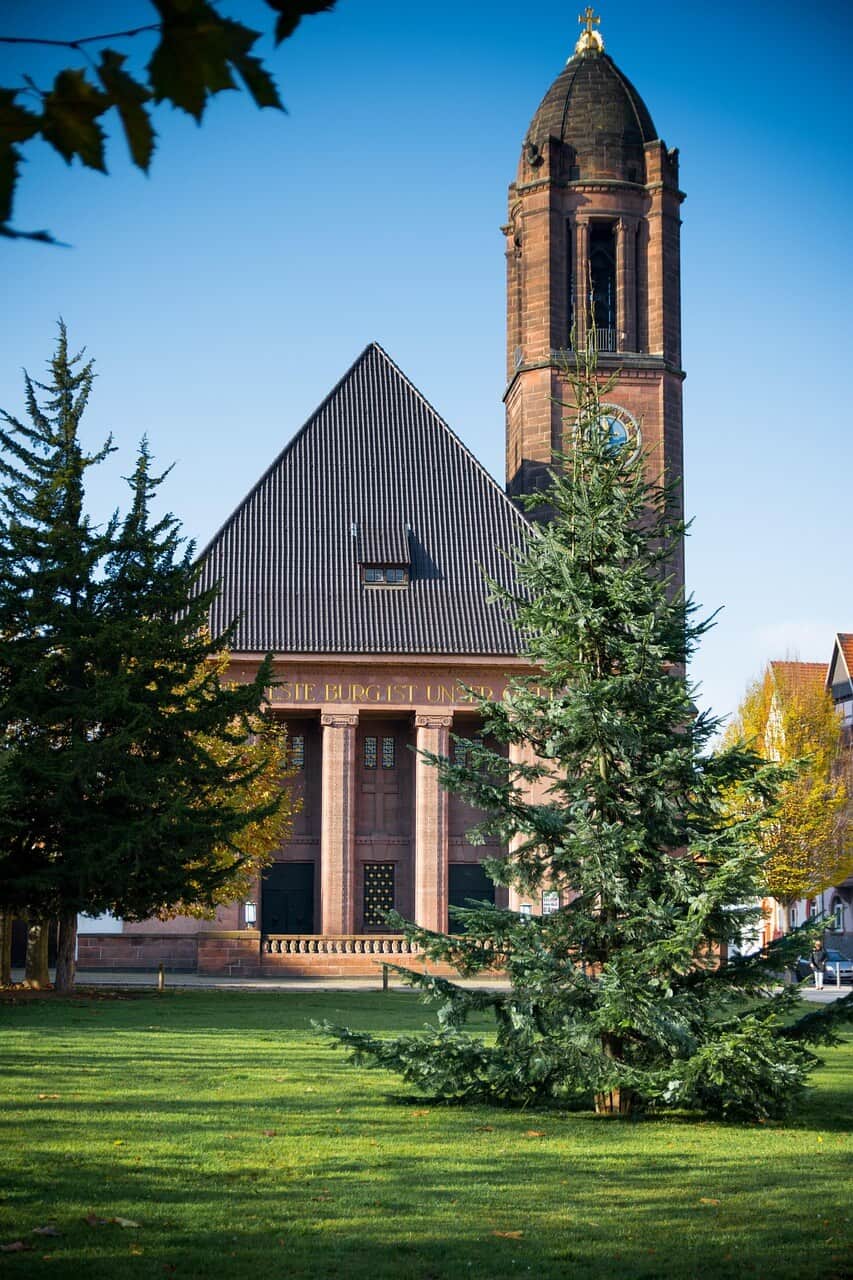
A skyline of stone – and a memory woven from stories
Worms is most visibly condensed around its cathedral quarter. St. Peter’s Cathedral is among the great Romanesque churches along the Rhine; its sheer presence seems to organise the city centre, as if it were a calm focal point around which everything turns. And yet Worms has never been only a “cathedral city”. It is the stage of major legal and imperial history – for instance through the Concordat of Worms (1122) – and it is also the setting of a narrative world that remains remarkably alive to this day: Worms is considered one of the central locations of the Nibelungenlied, written down around 1200. Here, myths don’t cling as folklore, but as a cultural echo: you sense them in places, in motifs, in recurring names – and sometimes simply in the way the city speaks about itself.
Jewish Worms: learning, memory, World Heritage
A second strand, just as defining, is Worms’ Jewish heritage. In the Middle Ages, Worms was part of an exceptional network on the Rhine: Speyer, Worms, and Mainz – the ShUM cities. In July 2021, their sites were recognised by UNESCO as World Heritage; in Worms, this includes, among other places, the synagogue complex and the Old Jewish Cemetery, “Holy Sand”. This recognition is more than a title. It stands for an intellectual tradition, for religious and legal thought, for daily life and scholarship – and for the fact that a city’s identity is also shaped by what has been preserved, destroyed, rebuilt, and retold over centuries. Walking through the Judengasse, you quickly understand why Worms is not simply one city among many in Europe’s collective memory.
From the Market Square to the Rhine: everyday Worms
And yet Worms wouldn’t be Worms if it were made only of grand chapters. The city has a very human, everyday side: the Market Square with the Trinity Church, the lanes and passageways of the old town, small paths that lead surprisingly quickly into greenery – and the Rhine, which changes your perspective. Within minutes, you can move from the stone-built centre to riverside paths that feel more like parkland and open space than like a city. To the south, broad recreational areas connect to Bürgerweide and the Rhine meadows, with trails, lawns, water features – and, nestled within it all, the zoo. Worms can be monumental and light at once: Romanesque architecture and imperial history in the morning, river air and green landscapes in the afternoon.
Perhaps that blend is exactly why Worms stays with you: because nothing here is merely a backdrop. The city is old, but not fossilised. It is conscious of its history, but not in love with pomp. And it is compact enough to experience a great deal without losing your way. Those who visit Worms don’t just visit sights – they encounter a city that has learned to live with its past, without locking itself inside it.